
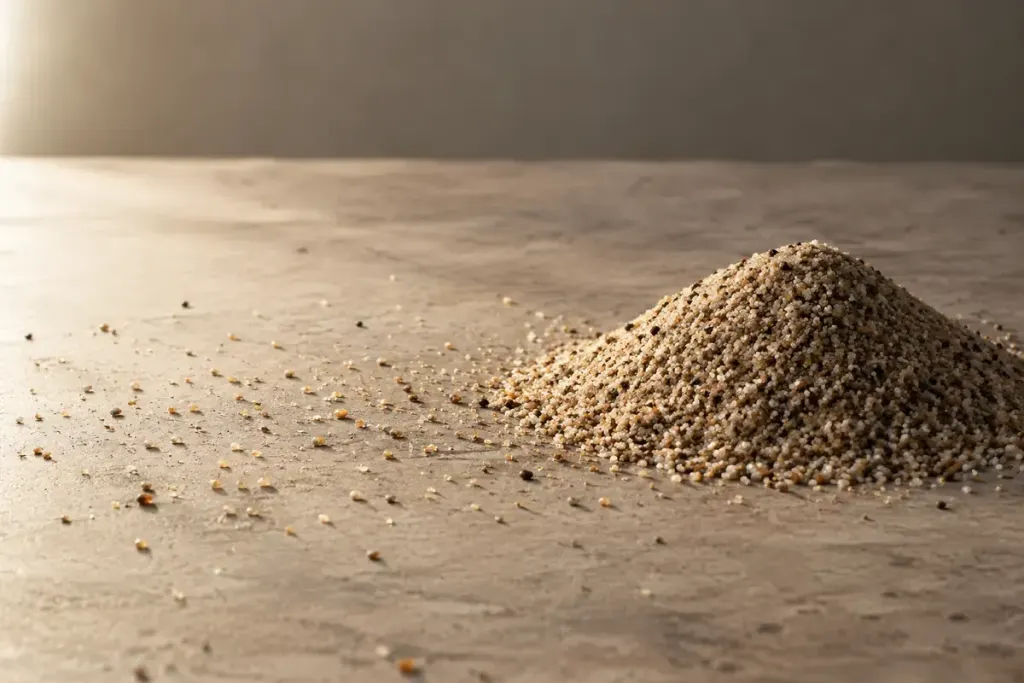
One grain of sand is not a heap. Add another: still not a heap. If adding one grain can never make the decisive difference, how could any number of additions eventually produce a heap?
This is the shape of the sorites paradox. The Stanford Encyclopedia of Philosophy’s account connects it with vague terms whose boundaries are unclear. The puzzle puts apparently reasonable small steps beside a conclusion we reject. It does not depend on sand being unusual.
Notice which claim does the hard work
The tempting step is that one tiny change cannot alter the classification. Repeating that step takes us from an obvious non-heap to an obvious heap without allowing the word to change. Starting with a heap and removing grains creates the same pressure in reverse.
Try writing the argument as three separate commitments: there is a clear starting case; each small change leaves the description unchanged; enough changes lead to a clearly different case. The tension becomes easier to see when those commitments sit together rather than arriving one grain at a time.
A practical threshold is a decision, not a discovery
Imagine a workshop that labels any scrap collection above a chosen weight a “large pile” for storage purposes. That rule may be useful. It gives staff a consistent action point, but it does not show that ordinary language secretly used that precise weight all along.
This distinction matters when a debate moves from a gradual property to a sharp administrative category. A chosen cutoff can serve a purpose while leaving borderline cases awkward. Ask what the threshold is for and what happens on either side of it.
Philosophers disagree about how best to resolve the paradox, including whether boundaries are unknowable or meaning itself needs a different treatment. For an everyday discussion, resist using “there is no obvious dividing line” as an automatic proof that no meaningful difference exists. The uncertain boundary is the problem to examine, not a reason to erase the clear cases at both ends.